
AARTD Internship programme
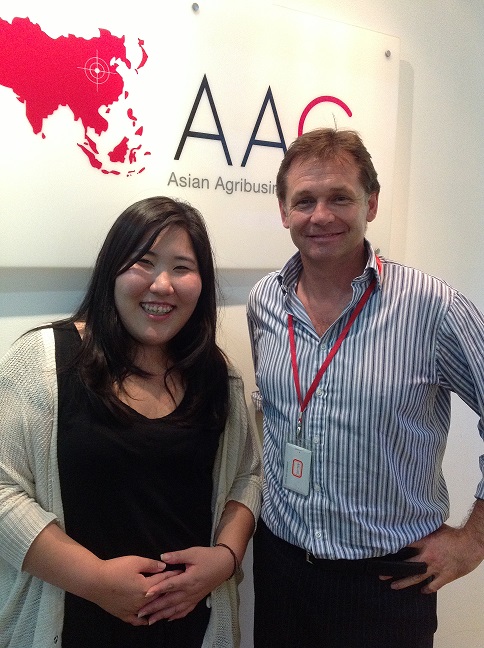
Michael Boddington and the team thank Soyoung, our intern from South Korea, for a great job!
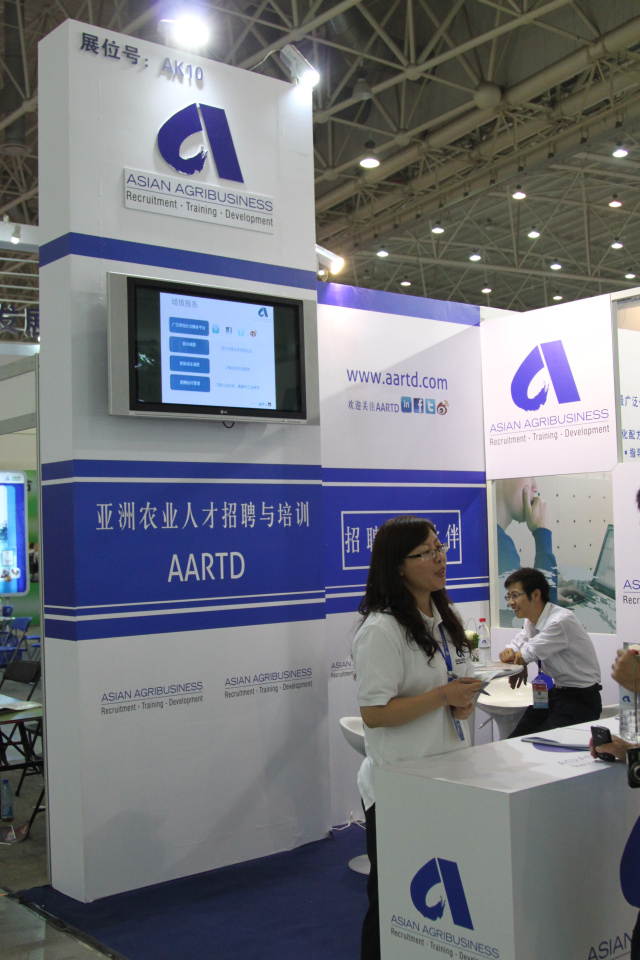
AARTD attended the 2013 CAHE Exhibition in Wuhan
The 11th annual Chinese Animal Husbandry Exhibition (CAHE) took place from 18-20 May in Wuhan, Hubei province, China.
The organizer China Animal Agriculture Association (CAAA) reported that visitors and exhibitors came from all over China and overseas including the Netherlands, USA, Denmark, Germany, the UK and France. The total number of exhibitors in this show amounted to 1,426 with 152 being international, and at it’s peak the total attendees (including exhibitors was 52,336 – making it a really worthwhile event to be involved in.
Our AARTD team really enjoyed meeting so many new and familiar candidates from across China and the world.
We are now working hard to match great opportunities with great candidates to meet your career goals.
Thank you to everyone who visited our booth and the team!
We will be in touch with you very soon!
Pig333.cn launches in China!
pig333.cn is a website focusing on the pig production chain from pig to pork.
It’s aimed at Veterinarians, Pig farmers, Researchers, and everyone in the Swine industry who want to keep up to date.
Register to see regular articles written by Swine Specialists from around the world.
Topics include health, management, environment, bio-security, welfare, genetics, facilities and markets, news, Pig prices, clinical case studies, events and more…
We are proud to welcome and su
pport this professional and informative website into the China market.
Visit the website at: www.pig333.cn

Pig333 launches in China
Vietnam’s Aquaculture Industry – An Update
The Vietnamese fisheries industry is growing and has Government support. In 2012 Exports hit US$6.2 billion, a 1% increase from the same period in 2011 against a projected value of US$6.5 billion. The slight under performance stemmed from lulls for Vietnam’s two most important export items (Shrimp and Pangasius), however other areas of the industry compensated by showing growth.
• Marine exports reached a record US$2.2 billion, +14.5% on 2011, mainly driven by Tuna exports (up 53.1%), other fin-fish (up 23.4%) and Crustacean improving by 9.3%.
The Vietnamese government has taken measures to improve an already positive Fisheries industry addressing areas recommended by VASEP:
• Tax incentives and projected market developments are expect to help Seafood Exporter and Pangasius farmers to combat difficulties obtaining capital in 2012, where nearly one third of Commercial companies and Exporters halted operations
• Environmentally friendly export packaging will benefit from tax breaks and refunds, to improve margins and free more capital to invest elsewhere
• Exporters get a 275 day grace period on tax payments for imported materials that are used for exporting goods
• Aquaculture Stewardship Council (ASC) is striving for 100% of Pangasius farms to be certified by 2015 (50% through ASC), to preserve environmental conditions and protect the industry and it’s investors
• Feasible replacement preservatives for Ethoxyquin are being sourced after Japanese authorities clamped down on testing (max residue limit 0.01ppm) causing a 6 month progressive decline in Shrimp exports to the market of 1.4% – 16.6%vs 2011
.
• Directorate of Fisheries (D-Fish) is striving to eliminate shrimp diseases like early mortality syndrome (EMS) that dramatically affected the industry in 2011
In 2012, the U.S. became (and continues to be) the largest importer of Vietnamese seafood (No:1 for Tuna and No: 2 for Pangasius), overtaking the European Union. This is partly due to 5.4% growth in export value compared to 2011.
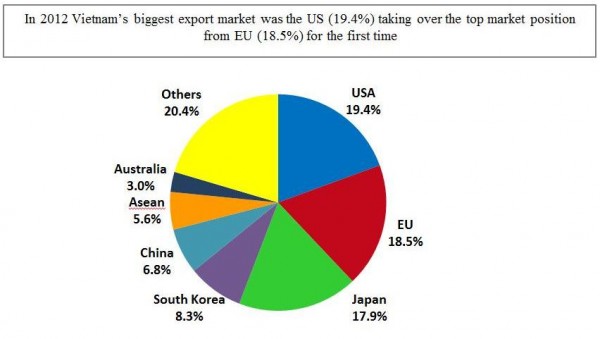
This upward trend continued in January 2013 with U.S. imports growing 22% on the same period last year and the three fastest-growing markets were ASEAN (+111.2%), China/Hong Kong (+97%) and Brazil (+88.9%). The main export earners were Shrimp (25.3% growth), Pangasius (40.7% growth) and Tuna (47.1% growth).
It is significant to note that the farmer’s species are producing the greatest return for the industry and thus are favorably supported locally. We believe that the consolidation of the industry will continue resulting in increased professionalism and traceability in an exciting growing industry.
For more information on the Vietnamese Aquaculture industry and information on the latest research please contact: michael@boddingtonconsultingcom. Sources: Vietnam Seafood News
Six Questions to Ask During Your Interview That Will Make an Employer Want to Hire You
 It’s common advice among job seekers: when you’re interviewing, you need to interview the employer right back. After all, you’re the one, who is potentially going to fill this position, so you need to know if it’s going to be a good fit, right?
While salary ranges, benefits and schedule flexibility are important details that you deserve to know about, Hiring Managers don’t appreciate questions like these until at least your second interview (or maybe even after an offer has been made).
During your first interview, the “impress me dance” is still in full swing. When a potential employer asks if you have any questions, they don’t want inquiries about parking validation; they want to see if you’re prepared, educated and inquisitive.
Here are six questions to ask in an interview that will help you master the twisted tango of getting hired:
1. If I were to start tomorrow, what would be the top priority on my to-do list?
The answer to this question will give you more insight into the current state of the position, while the question shows that you’re invested and interested in learning how you can start things off with a bang. The added bonus lies in the Jedi mind trick: now you’ve already got your interviewer picturing you as having the position.
2. What would you say are the top two personality traits someone needs in order to do this job well?
The answer to this will be very telling. “Creative” and “intuitive” can be translated to mean you will be on your own, while “patient” and “collaborative” could mean the opposite. Not only will this question allow you to feel out whether you’re going to be a good fit; it will also get your interviewer to look past the paper resume and see you as an individual.
3. What improvements or changes do you hope the new candidate will bring to this position?
This answer can shed light on what might have made the last person lose (or leave) the job, and it also tips you off on the path to success. Asking this shows an employer you are eager to be the best candidate to ever fill this position.
4. I know this company prides itself on X and Y, so what would you say is the most important aspect of your culture?
This type of question is sure to impress, as it shows that you’ve done your research on the company and gives you a chance to gain insight into what values are held to the highest ideal.
5. Do you like working here?
This question might take interviewers back a bit, but their answer will be telling. A good sign is a confident smile and an enthusiastic “yes” paired with an explanation as to why. If they shift in their seat, look away, cough and start with “Well…”, consider it a red flag.
Regardless of their answer, employers appreciate getting a chance to reflect on their own opinions, and this turns the interview process into more of a conversation.
6. Is there anything that stands out to you that makes you think I might not be the right fit for this job?
Yes, asking this question can be scary, but it can also be beneficial. Not only does it give you a chance to redeem any hesitations the employer might have about you; it also demonstrates that you can take constructive criticism and are eager to improve—valuable qualities in any candidate.
Source: LinkedIn Today : AARTD LinkedIn Group
Boom in live cattle exports to China
Demand for New Zealand dairy livestock in China appears to be booming, with more than 38,000 live animals leaving our shores for Chinese pastures last year. And one of the major buyers in China is the New Zealand dairy co-operative Fonterra.
One of the largest-ever shipments of live dairy cattle will head off on a three-week journey from Timaru to China in the next week, part of a growing trend of New Zealand cattle heading to Asia.
Brokered through South Island livestock company Peter Walsh and Associates, 7200 heifers worth upwards of $12 million are being exported by Australian-based Landmark Global Exports.
Demand for New Zealand dairy livestock in China appears to be booming, with more than 38,000 live animals leaving our shores for Chinese pastures last year.
And one of the major buyers in China is our own – the New Zealand dairy co-operative Fonterra.
One of the largest-ever shipments of live dairy cattle will head off on a three-week journey from Timaru to China in the next week, part of a growing trend of New Zealand cattle heading to Asia.
Brokered through South Island livestock company Peter Walsh and Associates, 7200 heifers worth upwards of $12 million are being exported by Australian-based Landmark Global Exports.
Eric Broad, Landmark’s national manager, said his company is one of several exporters operating out of NZ.
But Statistics New Zealand data shows 43,517 live cattle worth $112 million were exported from New Zealand in the year to November 2012.
Far and away the biggest recipient was China, which bought 38,232 dairy animals at a value of more than $100 million.
That’s a big increase on the year before; 25,000 animals worth $63 million were exported to China in the year to November 2011.
China has a clear goal to build its dairy industry to meet growing demand from an expanding middle-class.
Waikato dairy farmer Roger Blunt said exporting dairy cattle was “a big business”.
“The market’s very strong and it’s been a lucrative enterprise for farmers involved.”
Full Story : New Zealand Herald


