
PIC China Press Release
PIC China makes milestone shipment to Shennong
Yunnan Shennong Agricultural Industry Group (Shennong) has recently imported more than 1,000 elite, high-health great grandparent (GGP) from The PIG Improvement Company (PIC).
The shipment of elite pigs is a major milestone in PIC China’s partnership with Shennong, an integrated pork producer and one of the most progressive pig farming companies in China. It involved transporting 1,000 GGP gilts from PIC’s genetic nucleus facilities in North America and delivering them to Shennong’s facility. The animals recently completed a 45-day period of quarantine and are now being integrated into Shennong’s nucleus herds.
This move means PIC will have extended capacity to produce leading genetics for its customers across China and that Shennong will be able to grow its own commercial pyramid.
Coupled with technical support, this will enable PIC customers to accelerate genetic improvement through their production systems, enhancing performance, productivity and profitability as a result.
“The import is part of our strategy to ensure the best performing PIC genetics are available here in China” said Catalin Lapuste (Operations Director, PIC China). “We are committed to helping our partners across the country access such genetics as they pursue their commercial goals. This will help them develop world-class performance in their herds and ensure they remain highly competitive in the years ahead.”
PIC and Shennong have worked together for more than 13 years. This new milestone follows the signing of a new multi-year partnership agreement in July 2016, which included the stocking of a nucleus multiplication farm with the capacity to produce 30,000 grandparent gilts a year and the establishment of a sire line nucleus to produce high-quality terminal boars in China.


_________________________________________________________________________________
About Shennong
Yunnan Shennong Agricultural Group is one of the leading pig integrators in China. Shennong has established its pork supply chain of feed mills, pig production farms and slaughtering, meat processing and retailing business, aiming to expand its “farm to fork” integration by producing 1,000,000 market pigs annually. http://www.ynsnjt.com
About PIC
PIC is the international leader in the provision of continuous genetic improvement in swine breeding stock and in world class technical support to the global pork supply chain. PIC combines quantitative analytics with leading-edge biotechnology to develop breeding stock that helps our customers maximize profitability. The company, a division of Genus plc and founded in 1962, operates in 30 countries on 6 continents. www.pic.com
INDUSTRY NEWS(Pig Industry | Poultry Industry | Dairy Industry)
INDUSTRY NEWS(Wine | Whisky | Baijiu)
INDUSTRY NEWS(Animal Health | Animal Nutrition)
Brazil cuts into U.S. soybean market share in China
Brazil is expected to win a larger share of China’s soybean imports in coming months, hitting U.S. exporters during the peak marketing season for their most valuable farm product as the world grapples with a fifth consecutive bumper crop.
China is expected to buy about five million tonnes of soybeans from Brazil for the fourth quarter of 2017, two senior trade sources said, double the 2.49 million tonnes shipped over the same period last year.
For U.S. soybean exporters, the October-December period is crucial, accounting for an average of 53 percent of calendar year shipments for the past five years, according to U.S. Census Bureau trade data.
China, the top importer of American agricultural goods, ships in more than 60 percent of the oilseed traded worldwide. Brazil normally has little left for exports by around October, but a record 2016/17 crop of 114.1 million tonnes means it still has unsold stocks.
Full story
In pics: autumn harvest across China

A farmer airs corns in Chongqing, southwest China, Oct. 10, 2017. (Xinhua/Yang Min)

A staff member harvests apples in Dancheng County, east China’s Shandong Province, Oct. 10, 2017. (Xinhua/Fang Dehua)

A farmer harvests lotus roots in Lianyungang, east China’s Jiangsu Province, Oct. 10, 2017. (Xinhua/Geng Yuhe)

A staff member harvests apples in Dancheng County, east China’s Shandong Province, Oct. 10, 2017. (Xinhua/Fang Dehua)

A farmer loads rice in Lianyungang, east China’s Jiangsu Province, Oct. 10, 2017. (Xinhua/Si Wei)

Farmers harvest chrysanthemum in Huaining County, east China’s Anhui Province, Oct. 10, 2017. (Xinhua/Jiang Sheng)

A farmer harvests oranges in Danzhai County, southwest China’s Guizhou Province, Oct. 10, 2017. (Xinhua/Kai Shangyu)
Farmers across China get busy during harvest


A farmer harvests rice in Mudian Village of Mudian Township in Xuyi County of Huai’an, east China’s Jiangsu Province, Oct. 9, 2017. (Xinhua/Zhou Haijun)

A farmer harvests rice in Mudian Village of Mudian Township in Xuyi County of Huai’an, east China’s Jiangsu Province, Oct. 9, 2017. (Xinhua/Zhou Haijun)

Rice are seen in Mudian Village of Mudian Township in Xuyi County of Huai’an, east China’s Jiangsu Province, Oct. 9, 2017. (Xinhua/Zhou Haijun)

Farmers unload corn in Gouya Village of Dazhuang Town in Yinan County, east China’s Shandong Province, Oct. 8, 2017. (Xinhua/Xu Zhongting)


Farmers harvest rice in Jianhua Village of Zhonghan Town in Chaohu, east China’s Anhui Province, Oct. 8, 2017. (Xinhua/Ma Fengcheng)

Farmers harvest rice in Hebei Village of Shuangxi Town in Jing’an County, east China’s Jiangxi Province, Oct. 8, 2017. (Xinhua/Xu Zhongting)
SOURCE:Xinhua News Agency
Chinese blueberries attract attention at international gathering
 |
|
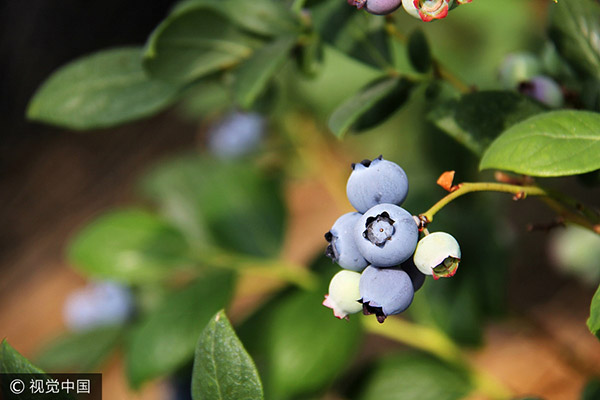
Clusters of berries. [Photo/VCG] |
The International Blueberry Organization is bullish on the prospects for the Chinese blueberry market, which is benefiting from huge demand on the part of Chinese consumers and an excellent production base in Qujing, Yunnan province.
“Qujing enjoys a unique natural environment and wild climate, which is suitable for the growth of crops. The blueberries produced in Qujing have a high quality, with high sugar content and hardness,” said Zhang Zulin, the deputy governor of Yunnan province, on Monday at the opening ceremony of the 2017 International Blueberry Organization Summit.
Zhang added that the Qujing blueberries could be sold on the market in April, which just makes up for the supply gap from international markets during that month.
Peter McPherson, chairman of the IBO, said China’s blueberry production industry stands out due to its huge market potential.
“The good thing that we’ve found is that the Chinese consumer loves blueberries,” said McPherson, adding that blueberries are an emerging industry in China and he is bullish about the prospects for the market.
IBO, a global organization, is aimed at bringing together leaders from around the blueberry world in all segments of the industry, collecting and sharing information and fostering a common goal of increased worldwide blueberry consumption.
It is the first time that the IBO Summit was held in China. Chile, Mexico, Australia, Argentina and Uruguay have previously hosted the summit.
As one of the leading blueberry production bases in China, Qujing has already planted 870 hectares of blueberries, representing 50 percent of the total blueberry production in Yunnan.
In 2020, blueberry production will reach 2,500 metric tons in Qujing and reach 250 million yuan ($38.3 million) in output.
Dong Baotong, the mayor of Qujing, said the government is making great efforts to develop the whole industrial chain related to blueberries, including the R&D of blueberry varieties, breeding of seedlings, planting, storage and sorting, logistics and retail, making Qujing a leading capital of blueberry production.
“In general, Yunnan province has the unique opportunity to produce blueberries during early season until the summer period if with the right variety, the right genetics, the right cultural system and right technology. It’s also possible to produce some in winter and spring. And that’s why a lot of international companies are looking for it in Yunnan,” said Cort Brazelton, founder of IBO and the director of Fall Creek Farm & Nursery Inc.
“I have enormous confidence of the blueberry growth in Chinese market. Like all other international companies, we are all excited and we have strong desire to work with the Chinese regional governments to help Chinese blueberry industry sustainable.”
China to give Ethiopia 15-mln-USD food aid
According to a press statement from the Chinese Embassy in Ethiopia on Wednesday, Liu Tao, Chargé d’Affaires at the Chinese Embassy, and Abraham Tekeste, Ethiopian Minister of Finance and Economic Cooperation, have signed the agreement.
The Chinese government has long committed itself to consolidating bilateral cooperation with and expanding support for Ethiopia, said Liu.
“With the newly offered food aid to Ethiopia, the Chinese government is determined to help tackle food security threats to the nation that have emerged in 2017, and is ready to extend further helping hands when necessary,” he said.
According to the latest UN statistics, 8.5 million of people require emergency food assistance between August and December 2017, noted the statement.
The statement recalled that Ethiopia, in 2016, suffered from the worst El Nino-induced drought in the past half century, which severely aggravated the already dire situation caused by failed rains in 2015, and the Ethiopian government had responded swiftly and effectively.
Reiterating China’s long-standing friendship with Ethiopia, the statement said that the Chinese government has been by the side of the Ethiopian government and people ever since the onset of this round of climate disasters.
In November 2015, Qian Keming, Vice Minister of Commerce of China, expressed profound concern over the situation in Ethiopia during his visit to Ethiopia and signed a food aid agreement, under which 10,535 tonnes of wheat was delivered to Ethiopia in April 2016.
In the same year, in a bid to further help relief efforts, the Chinese government donated 8 million dollars to World Food Program (WFP), providing emergency humanitarian food assistance to Ethiopian people.
In May 2017, Ethiopian Prime Minister Hailemariam Desalegn attended the Belt and Road Summit Forum for International Cooperation held in Beijing, China. On the occasion, leaders of the two countries announced to upgrade bilateral relations between China and Ethiopia to Comprehensive Strategic Cooperative Partnership.
“Looking into the future, the Chinese government, partnering with the Ethiopian government, will spare no effort to be of help whenever Ethiopian people is in need, jointly charting the course for the further enhancement of their enduring friendship,” said the statement.
DATE:2017-09-07 SOURCE:Xinhua
China targets farm waste as a ‘clean’ power source
BEIJING – China will pay farmers to turn animal poo into fertiliser and power, the Ministry of Agriculture said on Wednesday, as Beijing cracks down on agricultural pollution that has for years leaked into rivers and lakes, angering Chinese residents.
China will give farmers subsidies to build animal waste processing facilities to make fertilisers or to treat manure so it’s safe for disposal, and to install biogas plants that use methane to generate electricity, according a government plan announced on Aug 1.
The plan includes setting up recycling programmes by 2020 in 200 major counties that have livestock farms. That’s less than half the 586 major counties the government says have hog and poultry farms.
The agriculture ministry gave no details about the size of the subsidies, but the move could be a big step towards curbing chemical fertiliser use and cutting water pollution.
“We will help the farmers fully understand how organic fertiliser can improve energy efficiency and the environment,” said Zhong Luqing, director of the fertiliser department at the ministry, at a briefing on Wednesday.
Biogas technology, which can help save on electrical costs, is too expensive for many farmers unless the government helps.
Those researching and using organic fertiliser will also get preferential treatment on loans, taxes, power use and land rent, Zhong said.
Getting rid of animal waste is a major headache for livestock producers worldwide, partly because of the strong odour and damage caused to the atmosphere by the release of harmful gases. Run-off containing animal wastes can also seep into the water table and contaminate rivers and lakes.
In China, how to better dispose of animal waste has become a particular problem due to the fast growth of poultry and hog farming over the past decade to meet demand for higher quality meat. Chinese livestock farms generate nearly 4 billion tonnes of waste annually, according to the agriculture ministry.
“We will strengthen policy support and increase subsidies to support farmers to use organic fertiliser … especially large-scale farmers, family farms and cooperatives,” Zhong said.
The plan is part of Beijing’s effort to limit chemical fertilisers and pesticides, which have contaminated soil and water. China uses about one-third of the world’s fertilisers.
Beijing has said it was targeting zero growth of chemical fertiliser and pesticide by 2020. It has urged farmers to use less chemical fertiliser and turn to animal manure instead.
DATE:2017-09-04 SOURCE:China Daily


