
Vision and Action on Jointly Promoting Agricultural Cooperation on the Belt and Road
Since the world entered the 21st century, the pace for economic integration has quickened, giving rise to a new era of peace, development, cooperation and mutual benefit. In September and October of 2013, President Xi Jinping P. R. China proposed the initiative of jointly building the Silk Road Economic Belt and the 21st Century Maritime Silk Road (Belt and Road Initiative) during visits to Central and Southeast Asia respectively, which has attracted close attention from the world. Rooted in the principle of mutual consultation, joint efforts and shared interests, the Initiative is committed to a free trade system and an open global economy, encouraging countries along the Belt and Road (B&R) to achieve coordination of economic policies and jointly creating an open, inclusive and balanced regional economic cooperation architecture that benefits all.
Agricultural exchanges and trade were an important part of the ancient Silk Road, via which flax, pomegranate, alfalfa, grape and other plants came to China, and Chinese know-how and products like well digging, silk and tea went to Central Asia and farther. Countries were benefited from wider spread of farming skills and commodities. Agricultural civilization expanded and prospered in Asia, Europe and Africa through closer connectivity of countries. In the new era, agriculture remains the foundation of the national economy in B&R countries, and agricultural cooperation is their common pursuit since many long to fight hunger, eradicate poverty, and achieve food and nutrition security. Therefore under the Initiative, agricultural cooperation can be a good foothold for B&R countries to build a community of common interests and destiny.
In the past three years, great progress has been made in agricultural cooperation between China and countries along the Belt and Road. We have entered into proactive collaborations and connection through bilateral and multilateral cooperative mechanisms. Cooperative scope has expanded in width and depth, and is joined by increasing number of players in diversified ways. This Vision and Action is thus drafted to foster top-level design on agricultural cooperation along the Belt and Road.
I. Background
Now the world is undergoing profound and complex changes. As repercussions of the financial crisis linger on, the economy recovers at a slow pace, and development is uneven. Trade and investment landscape and multilateral rules are undergoing major adjustments. The Initiative to jointly build the Belt and Road, embracing the trend towards a multi-polar world, economic globalization, cultural diversity and greater IT application, is a positive endeavor to seek new models of international cooperation and global governance.
Transformation has also occurred in the global agricultural development structure in recent years. Climate change inflicts deeper and deeper impact upon major grain producing regions. Bio-energy, financial speculation and other non-traditional factors build up uncertainties in the global agricultural market. Food insecurity and poverty plague many developing countries, and there are still 795 million people suffering from chronic hunger and 2 billion people from malnutrition. Lack of momentum for a sustained growth and changes in the supply and demand structure at agricultural market are the new issues and challenges for countries all over the world to address jointly. Especially, it’s imperative for many countries along the Belt and Road to achieve food and nutrition security and eliminate hunger and poverty. So there is an urgent need to conduct cooperation to jointly promote agricultural sustainability.
In post financial crisis years, countries are even more committed to agriculture which is foundation of the economy, paying more attention to the integration and utilization of global agricultural resources and deep exploration of agricultural market, thus more aspirant to carry out cooperation. This brings historic opportunities for countries to promote agricultural cooperation under the Belt and Road Initiative. Now China is working closely with Belt and Road countries to dock strategies and build framework for cooperation. The bolstered bilateral and multilateral mechanisms offer platforms and infrastructure connectivity and financial intermediation provide guarantees to pursue the endeavor. Favorable conditions are laid for countries to achieve complementarities in agriculture and share development opportunities.
China’s agricultural sector and that of the world are closely connected. It is significant to boost agricultural cooperation along the Belt and Road, which is necessitated by the need for China to further expand and deepen the opening-up, and for the world agriculture to grow in a sound and sustained way. It is also significant in its conduciveness to shape the landscape of agricultural cooperation in the world, and tap comparative advantages of countries along the Belt and Road. It will foster orderly flow of factors, efficient allocation of resources, and deep integration of markets in the region, and facilitate B&R countries to gain economic benefits and win-win growth. Since late 1970s, China has scored achievements in agriculture and rural areas and made contributions to the world food security. Committed to shouldering more responsibilities and obligations within its ability, China is ready to contribute its wisdom to the global governance on food and agriculture, and share experience with Belt and Road countries so as to contribute more to agricultural and economic growth in the world.
II. Principles
Policy coordination. Countries along the Belt and Road are supported to conduct vision matching and policy dialogue, seek convergence of interests and the maximum common interest, and jointly hammer out the top-level design for key areas, leading industries, and important products of common concerns. Existing mechanisms should be fully tapped to drive forth long-lasting agricultural cooperation along the Belt and Road in an innovative manner.
Market operation. Companies are leading players. Market is to play the decisive roles in resource allocation, and market rules and international norms are to be followed. Enterprises will be supported to conduct cooperation among them to seek complementarities and common development.
Government service. Cooperation mechanisms among governments will guide and work for agricultural cooperation along the Belt and Road. Efforts will be made to deepen opening-up, improve investment and trade facilitation, set up or improve the service network, and optimize the atmosphere for cooperation.
Green and sharing. Countries are respected to choose their own development path and mode. Agricultural cooperation along the Belt and Road echoes goals on food and agriculture of the 2030 Agenda for Sustainable Development, and advocates the principle of mutual consultation, joint efforts and shared interests for a green Silk Road. Concerted efforts are solicited to realize agricultural modernization with high efficiency, product safety, resource conservation and environmental consciousness.
Mutual benefit. Interests and concerns of all parties will be accommodated, advantages in agriculture of all countries be synergized, and cooperative potentials tapped. Cooperation along major economic corridors will be cemented to drive forward the whole cooperation process and build new cooperative ties along the Belt and Road marked by interdependence, mutual benefit, equality, safety and efficiency.
III. Framework
The Belt and Road run through the continents of Asia, Europe and Africa, connecting the vibrant East Asian economic circle with a long farming history at one end and the developed European economic circle with advantages in modern agriculture at the other. It links up countries with rich resources and huge potential across vast regions that enjoy advantages and complementarities in agricultural resources, technologies, productivity, and markets.
It is the shared vision and aspiration for countries along the Belt and Road to promote cooperation and develop agriculture. China is ready to work together with Belt and Road countries to plan and implement a group of key projects and build the new structure of agricultural cooperation with links running eastward and westward over land and sea, which supports the shaping of the community of shared interests, the community of shared responsibilities, and the community of shared future along the Belt and Road.
The Chinese government proposes that Belt and Road countries seek complementarities through stronger connection of strategies on agricultural cooperation, on basis of the principle of mutual consultation, joint efforts and shared interests and concepts of peace and cooperation, openness and inclusiveness, mutual learning and benefits under the Belt and Road Initiative, accommodate interests and concerns of all parties involved, proceed from science and technology, focus on policy coordination, facilities connectivity, unimpeded trade, financial integration, and people-to-people bonds to deepen collaborations on optimal technologies, priority products, and trade and investment along the six economic corridors (new Eurasian Land Bridge, China-Mongolia-Russia, China-Central Asia-West Asia, China-Indochina Peninsula, China-Pakistan, and Bangladesh-China-India-Myanmar), and work jointly for a full-fledged and wide-ranged new cooperative relationship.
IV. Priorities
Belt and Road countries, with great potential and broad fields for cooperation, need to proceed from common development goals and advantages to seek closer collaborations in the following key areas:
Policy dialogue platform. We should enhance policy communication, improve existing policy dialogue mechanisms at different levels, and establish a tripartite policy dialogue platform for governments, institutes, and enterprises to exchange views on development and dock strategies, work out plans and measures to press forward cooperation, address problems through consultation, and provide policy support for pragmatic cooperation and implementation of key projects.
Agricultural science and technology. We should prioritize science and technology cooperation and strengthen knowledge sharing, technology transfer, information communication, and personnel exchanges through multiple channels. In accordance with needs of countries along the Belt and Road and the bigger picture of international cooperation on agricultural science and technology, we should establish joint labs, experiment and demonstration bases and agricultural science and technology demonstration parks (zones), prevent and control animal and plant diseases and outbreaks, and conduct germplasm exchange, joint research and showcase of findings to enhance exchanges on species, technology, and products. We should jointly build the public information service platform(s) for agricultural cooperation along the Belt and Road, the technical advice and service system(s), and high-end think tank(s) and training base(s), so as to promote regional Internet of Things in agriculture and capacity of B&R countries to grow agriculture.
Agricultural trade. We should jointly build routes and infrastructure for integrated logistics such as transportation and storage so as to improve facilitation, increase volumes and expand fields on trade. We should encourage building all kinds of stable channels for trade of Belt and Road products and boost cross-border e-commerce. We should have closer cooperation on inspection and quarantine, and jointly develop safe, efficient and convenient traceability system(s) and supervision and control measures to inspect and quarantine imports and exports so as to regulate market behaviors and secure a higher level of animal and plant health and safety in Belt and Road countries.
Agricultural investment. We should draw on comparative strength in agriculture and cooperative mechanisms and channels of international financial institutions to increase investment in infrastructure and the whole industrial chain including production, processing, storage, transportation and distribution and impel the implementation of key projects. We should upgrade collaborations among enterprises, adopt all possible ways to improve their capacity and profile for transnational investment, and promote mutually beneficial growth of agribusinesses. We should encourage two way investment into agriculture. China welcomes agricultural investment from enterprises of Belt and Road countries and encourages Chinese enterprises to take up social responsibilities and contribute to agricultural development along the Belt and Road by assisting the host country to advance agriculture, create employment opportunities, and improve livelihood.
Capability building and non-governmental exchanges. We should foster farmer-focused capacity building and non-governmental exchange activities. Efforts should be made to jointly provide vocational education and training to empower farmers with necessary capacities and organizational skills, and build up confidence and trust among involved countries. We should also collectively build training bases for transnationals to cultivate all around talents and managers.
V. Mechanisms
For smooth implementation of collaborative activities as planned, countries along the Belt and Road should build on existing mechanisms and improve modalities creatively to vigorously promote agricultural cooperation.
Bilateral cooperation between governments. We should conduct communication and consultation at different levels through various channels to seek comprehensive development of bilateral relations so as to support agriculture cooperation. We should facilitate signing of memorandums or formulating of plans on agricultural cooperation under the MOUs of cooperation on the joint development of the “Belt and Road” between governments. We should play the role of existing high-level cooperative mechanisms to attract more Belt and Road countries and territories as well as international and regional organizations to set up high quality active agricultural cooperation mechanisms. We should underscore intergovernmental talks on treaties and instruments to accelerate the signing of bilateral investment and trade agreements, and enhance communication and coordination to heighten cooperation on investment protection, finance, taxation, customs clearance, inspection and quarantine, and personnel exchanges to meet enterprise needs with government services, thus creating a sounder environment and better conditions for agricultural cooperation along the Belt and Road Multilateral cooperation mechanisms. We should deepen cooperation with IOs and give full play to existing agriculture related multilateral mechanisms such as the G20, APEC, SCO, UNESCAP, the Asia Cooperation Dialogue, the League of Arab States, China–ASEAN, and the Lancang-Mekong Cooperation. We should also deepen cooperation with the WTO, FAO, OIE, IPPC, IFAD, WFP, and the CGIAR, and with global and regional developmental financial institutions such as the WB, ADB, NDB, AIIB, and SRF to explore new financial services, thus creating an open, inclusive, equitable, competitive and mutual beneficial environment for agricultural cooperation.
Major conferences and forums. We should make the most of platforms set up by major conferences and forums such as the China-Africa Cooperation Forum, the Boao Forum for Asia, Roundtable Meeting on ASEAN Plus Three Food Security Cooperation Strategy, the China-ASEAN Exposition, the China-South Asia Expo, the China-Eurasia Exposition, the China-Central and Eastern European Countries Economic and Trade Forum, the China-Central and Eastern European Countries Cooperation Forum on Entry-Exit Animal and Plant Quarantine & Quality and Safety of Agricultural Products, and the China-Arab States Exposition. Within the framework of the Belt and Road Forum for International Cooperation, we should establish a dialogue mechanism for Belt and Road agricultural cooperation, a research and communication platform for agricultural planning, and an information-sharing platform for agricultural resources, industries, technologies, and policies at the Belt and Road portal.
Overseas agricultural cooperation parks (zones). We should work together to jointly build agro-industrial parks to seek cluster and platform effect so as to reduce the cost of agricultural cooperation and prevent risks. We should also guide and support enterprises to participate in parks’ construction and operation, and infrastructure development in sectors including planting, animal farming, processing, and logistics to optimize the agro-industrial chain, thus supporting the connectivity of the economic corridors and the maritime Silk Road. Demonstration zones for agricultural cooperation can be jointly established on basis of aspiration and local conditions of B&R countries to support and showcase Belt and Road agricultural cooperation
VI. Action and Future
The Chinese government has been promoting and expanding the opening-up of agriculture and optimizing policy frameworks to partake in the process of agricultural globalization. The Belt and Road countries have been priority areas for China to have cooperation in agriculture for years. Many provinces and autonomous regions have taken advantage of their linkages in location and culture with neighboring countries for conducive and productive cooperation. Western provinces and autonomous regions collaborated with Central Asian countries in dry-land farming of grain, cotton and animal production, while northern provinces worked together with Russia in cereal and vegetable production in the Far East region, and southern provinces proceed from tropical agriculture to engage in cooperation with Southeast Asia and South Asia on grain and cash crop cultivation. All have made notable achievements. In addition, China has explored many ways to assist B&R countries to raise production and improve the ability for safety and health control such as construction of technology demonstration centers, fielding experts, and training technicians and administrators, thus making positive contribution to the world food security.
In the future, China will keep promoting agricultural cooperation under the Belt and Road Initiative by partaking in the development of regional agricultural cooperation platform(s), supporting talks on agriculture-related trade and investment agreements bilaterally or multilaterally, jointly devising the plan of bilateral cooperation on agricultural investment, increasing agricultural investment in least developed countries, facilitating implementation of 10 cooperation plans between China and Africa, mobilizing the “South-South Cooperation Assistance Fund” and promoting South-South Cooperation in agriculture, supporting developing countries to implement the 2030 Agenda for Sustainable Development, engaging in agricultural cooperation with developed countries innovatively, assisting in formation of a new pattern of relationship on agricultural cooperation, and promoting agricultural sustainability in the world.
Next, China will promote building of overseas demonstration parks (zones) for agricultural cooperation and domestic cooperative experiment zones for agricultural opening-up and cooperate with Belt and Road countries in finance, taxation, insurance, and inspection and quarantine of animals and plants, bolstered exchanges of personnel and information, sharing of agricultural technologies, experience, and development modalities, and jointly planning and implementing seven key projects, i.e. enhancing comprehensive grain productivity in the region, science and technology cooperation and demonstration, joint prevention and control of animal and plant diseases and outbreaks, agricultural vertical integration, strengthening trade infrastructure, building the platform for agricultural R&D and training, and developing IT application network(s) for agriculture.
The Belt and Road Initiative is proposed by China but shares common aspiration of countries along the route. China is ready to work with Belt and Road countries under the existing bilateral and multilateral cooperative mechanisms and frameworks and walk toward each other to promote agricultural cooperation along the Belt and Road to another broader and higher stage that respects interests and appeals of all parties concerned. China is willing to make greater contribution to food and nutrition security and agricultural sustainability in the world.
Source: MOA Date: 2017-05-15
China’s taste for Australian beef a blessing for the industry

A continually growing demand for Australian cattle from China is likely to make the industry going from strength to strength, according to experts who are lauding China’s taste for Aussie beef.
Following news that Australia’s richest woman and mining magnate Gina Rinehart was seeking to ramp up cattle exports to China, industry experts have said that Australia’s beef industry was likely to see a robust growth.
Michael Whitehead from the ANZ Bank’s agribusiness sector overnight told News Corp that it is was no wonder Australia’s richest were continuing to pour their money into the beef industry, citing Rinehart and retail giant Gerry Harvey as examples of prime beef investors.
“Being in control of the start of the beef supply chain is a great place to be if protein is going to be increasingly in short supply,” Whitehead said of Australia’s beef industry.
“Investors, too, are starting to look for industries that can’t be disrupted. You can disrupt banks, hotels, media, taxis and property, but how do you disrupt Australian beef?”
“So it follows that if you are a billionaire, it is obvious that you will never lose your money by buying and investing in Australian cattle properties. It’s a great project and space to be in.”
Harold Mitchell, a prominent Australian beef investor, told News Corp that unlike the mining boom, after which demand for resources dropped, it was highly unlikely that a demand for basic proteins such as beef would subside, instead predicting that demand would continue to rise for decades to come, even if prices come down when supply catches up with demand.
“I’ve been a great supporter of the industry and still think it has a long way to go. There will always be a shortage of protein in a growing world,” he said.
“The China trade is just starting to take off and the US has had so much demand for our hamburger meat; but things are changing fast and we are right at a point where the price of stock is so high that I fear a (price) collapse is coming.”
He said if Australian suppliers could breed more beef cattle, Australia would be able to meet the demands for both local and overseas consumers for decades in the future.
Source: China Daily Date: 2017-05-12
Thailand sugar production rises

Thailand produced 10 million tonnes of sugar from 93 million tonnes of sugarcane during the 2016-2017 crop from December 6, 2016 to the first week of May 2017.
The figure represents an improvement on last year, when the country produced 9.8 million tonnes of sugar from 94.5 million tonnes of sugarcane.
Rains in several sugar planting areas resulted in abundant sugarcane with higher sugar content.
Better yields in the 2016-2017 season has benefited Thailand, the world’s second largest sugar exporter, especially with global sugar prices on the rise, a situation likely to encourage farmers to switch from rice to sugarcane.
Previously, experts projected that global sugar production will increase to 190.3 million tonnes in 2017-2018 crop from 176.9 million tonnes in the 2016-2017 crop.
Source: VNA Date 2017-05-12
Hanoi’s hi-tech farm expansion remains slow

Agricultural production in the capital city remains small-scale and outdated, despite successful land reform and investment in irrigation networks for many years, says the Nong Thon Ngay Nay (Countryside Today) newspaper.
The outdated production methods are due to slow application of modern technologies, and it has led to low economic values.
Land use certificates have been successfully granted, which is a prerequisite for farmers to expand production or contribute land as a capital contribution to investment projects.
However, the city’s agricultural production has not yet reaped high economic value because most of households still use traditional production methods.
Explaining the slow application of technology in agricultural production, Chairman of the Quoc Oai District People’s Committee, Nguyen Manh Quyen, told the paper that “at present the municipal authority fixed land areas for rice planting”.
“This is an obstacle for transitioning the land for other crops that require high technologies and bring higher economic values,” said Quyen.
However, in Quoc Oai District, some businesses have bought lands from residents to set up hi-tech farms and achieved some progresses, he said.
Still, though, businesses face the difficult fact that agricultural land prices rocket upward when locals hear about hi-tech farming projects, he said.
Analysing the situation, Dr. Dang Van Dong, director of the Vegetable and Fruit Institute, said “this is due to ineffective management and a lack of close co-operation among farmers, businesses, scientists and authorities”.
“So far, we haven’t mobilised sources from domestic private and foreign businesses to invest in hi-tech farming,” he said.
Chu Phu My, director of the Hanoi Agriculture and Rural Development Department, said in the context of fierce climate change and rapid urbanisation, farming is indispensable to surviving and competing in the international integration process.
The capital city set a goal that by 2020, hi-tech agricultural production value will account for 35 percent of the total agricultural value.
However, so far, the hi-tech farming area designated for 2016-2020 is still slow, according to review of the city’s steering committee of new rural development.
According to Ha Minh Hai, director of the Hanoi Finance Department, appropriate policies are considered a prerequisite for luring capital to hi-tech farming. Each local needs to review agricultural production plans to attract investors.
Source: VNA Date 2017-05-12
AARTD大家庭将会参展位于青岛举办的中国畜牧业博览会。期待与您们相见,并共同欢庆AARTD 成立十周年!
AARTD大家庭将会参展位于青岛举办的中国畜牧业博览会。期待与您们相见,并共同欢庆AARTD 成立十周年!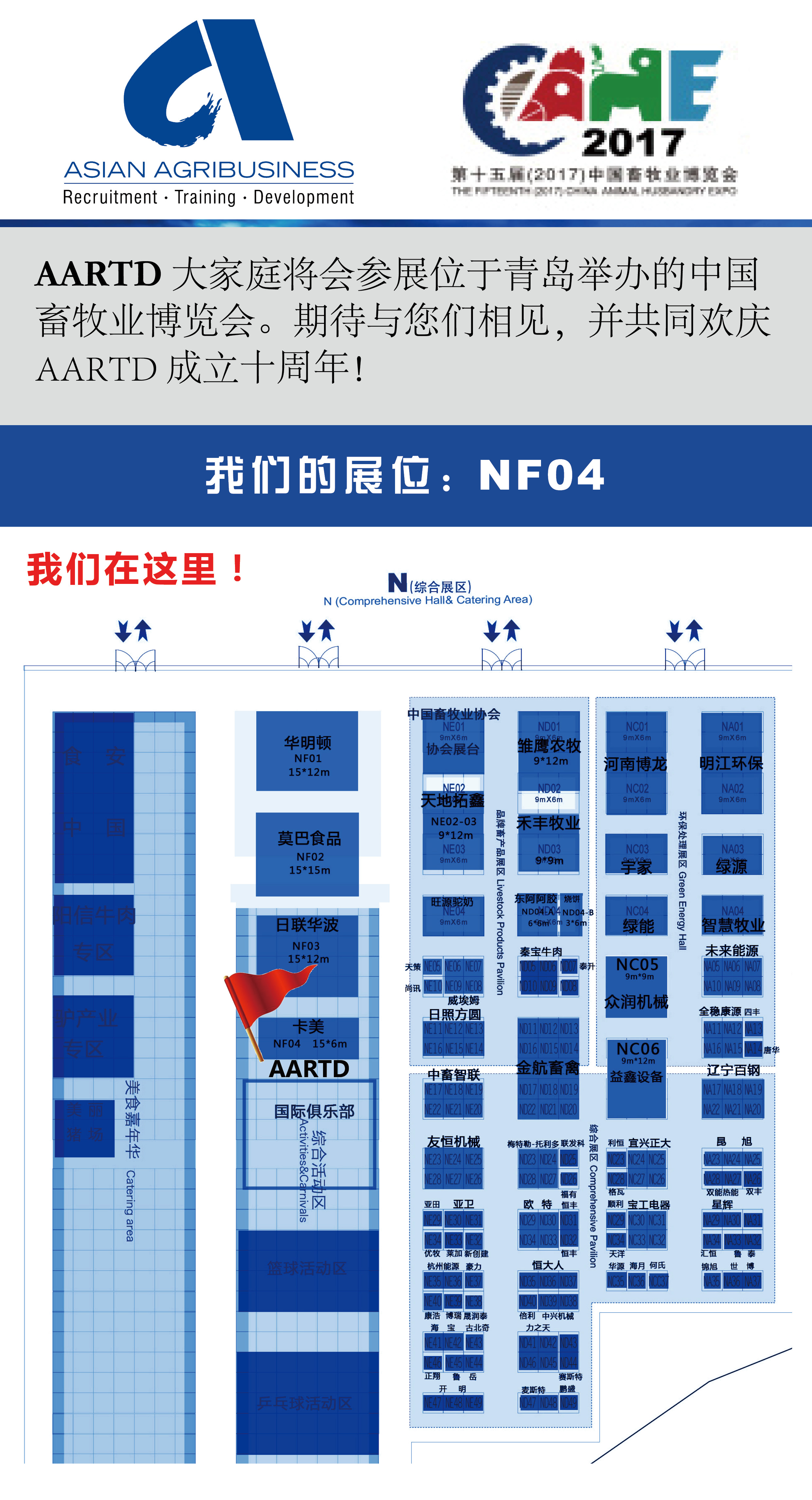
3rd Meeting of China-Argentina JCA held in Beijing

Mr. Zhang Zhongqiu, China’s Chief Veterinary Officer and Ms. Marisa Bircher, Secretary for Agroindustrial Markets of the Ministry of Agroindustry of Argentina, co-chaired the Third Meeting of China-Argentina Joint Committee on Agriculture (JCA) in Beijing on the afternoon of 27 April 2017.

The two sides reviewed the achievements of bilateral agricultural cooperation, spoke highly of the efforts made on mechanism development, agricultural trade and two-way investment, and looked forward to greater success in pragmatic cooperation. The two sides exchanged views on the Strategic Action Plan on Agricultural Cooperation between the Ministry of Agriculture of China and the Ministry of Agroindustry of Argentina 2017-2022 and agreed to conduct cooperation in 14 areas such as agricultural bio-technology, seed and scientific research.
To enhance agricultural cooperation, the two sides reached the following consensus: firstly, improving multilateral and bilateral agricultural cooperation mechanisms and enriching existing bilateral agricultural cooperation; secondly, strengthening cooperation in agricultural research and development and improving innovation capability of both countries; thirdly, facilitating bilateral cooperation on agricultural trade and investment and promoting connection and integration of agricultural sectors for mutual benefits and win-win outcomes.
After the meeting, the two sides signed the minutes of the third JCA meeting between China and Argentina.

SOURCE:MOA Information Office
VAT to be reduced on agricultural products in July
Value-added tax on agricultural products and some other goods will be reduced starting in July, the Ministry of Finance said on Wednesday.
The value-added tax rate faced by companies to import or sell agricultural products will be reduced from 13 percent to 11 percent, according to an online announcement by the ministry.
Companies that import or sell forage products, vegetable oil, natural gas and books will also receive the same level of tax cut benefits, the ministry said.
After the measures are implemented in July, the value-added tax regime will be simplified by combining four tax rates into three, with the 13 percent tax rate being elminated and keeping the 17, 11 and 6 percent tax rates.
The announcement was made after top leaders decided to roll out measures to lower the tax burden on enterprises during the State Council executive meeting held in April.
Zhang Bin, a senior researcher with the Chinese Academy of Social Sciences, said measures targeting specific key sectors, such as agriculture, will help lower the costs of enterprises amid economic downward pressure.
China launched value-added tax reform in 2012, and it was extended to the construction, real estate, finance and consumer services sectors in May last year.
Source:Chinadaily.
Xinjiang rural labor forces to receive skill training
From this year onwards, Xinjiang Uygur autonomous region is to carry out skill training for the rural labor forces, in order to tackle the shortage of skilled workers.
With focus on skill cultivation and upgrading, the annual training will comprise of 300,000 people, while the project is valued at 1.5 trillion yuan ($217.9 billion).
According to the government paper issued on April 14, Xinjiang natives are to account for over 70 percent of the total employed people for the project, including 40 to 50 percent coming from poverty-stricken families. The construction companies will have the native people undertake 90 percent of the unskilled work.
By 2020, the end of the 13th five-year plan, the government plans to provide training for over 1.2 million people. The rural labor personnel who are seeking job for the first time, or those who have no experience or formal training, need to go through a complete set of personnel training in terms of the national commonly-used language, discipline, physical capabilities, as well as general and professional skills.
“The plan will help to take the residents out of poverty by teaching them to ‘fish’ while solving the labor shortage”, said Yu Huan, deputy secretary general of the autonomous regional government.
Yu also stressed that the institutes are supposed to bear the responsibilities to ensure the qualifications of each trainee for the job upon the finishing of their training.
SOURCE:China Daily
2nd Meeting of China-Philippines JCF held in Manila
The Second Meeting of the China-Philippines Joint Committee on Fisheries (JCF) was convened in Manila, the Philippines on April 26, 2017.
The Chinese delegation, composed of representatives of the Ministry of Agriculture, the Chinese Embassy to the Philippines, research institutes and local governments and enterprises, attended the meeting and held talks with the Philippine delegation which consisted of officials from the Philippine Department of Agriculture and the Department of Foreign Affairs, as well as the Philippine Embassy to China.
The two sides exchanged views on respective priorities and governance policies in domestic fisheries development, discussed the key areas, basic principles and government measures for bilateral fisheries cooperation, and conducted friendly consultations on the proposed 2017-2019 JCF cooperation programs.
The two sides reached a preliminary consensus on carrying out technical training and exchange activities, facilitating business cooperation, bolstering mariculture and strengthening aquatic product processing, among other things.
The Chinese side noted that both China and the Philippines are major fisheries countries in the world while China is also a major consumer of aquatic products.
The fishing industry is important for both countries and plays a critical role in promoting the employment and income growth of fishermen, and boosting rural economy and social development.
China has attached great importance to the fisheries cooperation with the Philippines, hoping to advance pragmatic collaboration on the basis of mutual benefits and equality.
The Philippine side briefed on its priorities and key measures for domestic fisheries development, and asked China for germplasm transfer of four freshwater species, and assistance in technical capacity building on five subjects.
China introduced its fisheries development across the country, the planned layout of fishing industry during the Thirteenth Five-Year Plan period, and the overall consideration for bilateral cooperation.
In response to the requests of the Philippine side, China put forward a draft MOU on China-Philippines Cooperation of Fisheries Technical Training and Exchange, and pledged to donate 100,000 Leopard Coral Grouper (Plectropomus spp.) seeds to the Philippines annually from 2017 to 2019.
The Philippine delegation extended appreciation for that and the two sides also discussed five business-to-business initiatives including the deep-sea breeding and aquatic processing in Davao, fingerling breeding and deep-sea cage culture in Palawan, tilapia development in Zambales, and so on.
The Philippine side expressed support for the above initiatives and pledged to enhance coordination and address concerns of businesses.
After the meeting, the two sides signed the Minutes of the 2nd JCF meeting, and the Chinese delegation witnessed the signing of the cooperation agreements between fisheries enterprises.
The meeting was held in line with the MOU on fisheries cooperation between the two ministries signed in Beijing in September 2004, marking the resumption of the JCF since its 1st meeting in Manila in 2005.
The meeting also decided that the next JCF meeting is scheduled in China in 2018.
SOURCE:MOA Information Office
Trump nominee for China ambassador pledges to “positively influence” US-China relationship
 |
|
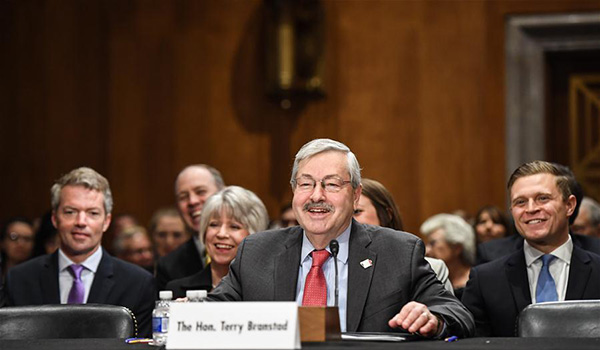
Iowa Governor Terry Branstad (Front) testifies before the US Senate Foreign Relations Committee on a hearing considering him to be US Ambassador to China on Capitol Hill in Washington DC, the United States, on May 2, 2017. US President Donald Trump’s pick for Ambassador to China, Terry Branstad, said on Tuesday that if confirmed, he would work to “positively influence” the US-China relationship. [Photo/Xinhua] |
WASHINGTON – US President Donald Trump’s pick for Ambassador to China, Terry Branstad, said on Tuesday that if confirmed, he would work to “positively influence” the US-China relationship.
“As Governor of Iowa, I saw first-hand the importance of a positive and healthy trade relationship between our two countries,” Branstad said here at his confirmation hearing.
If confirmed, he hoped to work towards the goal of positively influencing the US-China relationship, he added.
As the governor of a US state whose economy is mainly driven by agriculture industry, Branstad noted that almost one out of every two rows of Iowa soybeans is sent to China, as well as 33.5 million US dollars in pork in 2016.
However, the importance of trade between the United States and China extends well beyond agriculture, he said.
“Aviation products, manufactured goods, chemicals, electronics, and many other products and services are exported to China daily and help support and sustain the American economy,” he told US lawmakers.
Calling US-China relationship “multi-faceted,” Branstad also noted that the two countries must work together on major security issues, including the denuclearization on the Korean Peninsula and cybersecurity.
Branstad also said that he looked forward to “connecting with the Chinese people and continuing a vibrant exchange of culture and ideas.”
Branstad, 70, is the longest-serving governor in the United States, who also has long nurtured a close relationship with China and has visited China multiple times.
He served as the governor of Iowa in 1983-1999, and again since 2011. He was nominated by Trump to be the next US ambassador to China in December 2016.
Source:Xinhua


