
30% of VietGAP certified aquaculture farms in 2015
By 2015 there will be 30% of intensive, semi-intensive farms and aquaculture systems that are VietGAP certified and this percentage in 2020 will be 80%.
The application of VietGAP standards is considered crucial measures to minimize the negative impacts of aquaculture, to develop sustainable farming; and to enhance product value and, to promote export activities.
Pangasius and shrimp, two major farmed species, are equally economically efficient. Pangasius production reached 1.1 million MT with total farming area of 5,200 ha while brackish water shrimp yeild was 550,000 MT from the total farming area of 666,000 ha. Mekong Delta is the largest area of farming these species.
Michael Boddington from Asian Agribusiness Recruitment Training Development (AARTD) has been involved in agribusiness in Asia since 2000. AARTD has office both in Vietnam Ho Chi Minh City and China Beijing. So AARTD has a thorough understanding of the Vietnam and China agribusiness industry and produces up-to-date research reports on the market. We can offer insights on supply and demand trends and comments on the future structure of Asian agribusiness. If you would like to know more please email: michael@boddingtonconsulting.com
Source: http://seafood.vasep.com.vn/whybuy/657_10318/30-of-vietgap-certified-aquaculture-farms-in-2015.htm
Meat processor to acquire Primo-Austrailia
SYDNEY | Australia’s largest fresh meats processor, JBS Australia, has signed a $1.45 billion deal to acquire Primo Group, the largest ham, bacon and smallgoods producer in Australia and New Zealand.Primo owns brands including Primo Smallgoods, Hans and Beehive.
Its operations include five processing plants operating across Australia as well as New Zealand, employing more than 3000 people. The transaction is set to leverage the Primo Group’s growing export operations across Asia, including China, and is consistent with the global strategy of JBS to grow its presence in value-added products.
Primo Group chief executive Paul Hitchcock said he welcomed the sale to JBS.
“While it will remain very much business as usual for our employees, suppliers and customers, this transaction offers tremendous opportunities for a producer of high-quality products like Primo,” Hitchcock said. “We look forward to being part of JBS and capitalising on its international distribution network.”
JBS chief executive Wesley Batista said the acquisition was strongly aligned with his company’s global strategy to expand its presence in the value-added product category with well-known brands.
“Primo Group is the leading company in this segment with strong brands and represents an outstanding opportunity to grow our business in Australia and internationally.”Primo Group was established in 1985 by Paul Lederer and other family members.
In October 2011, Asia-Pacific based private equity firm Affinity Equity Partners acquired 70.1 per cent of the group. Since then, Primo has built a food manufacturing facility in Wacol, Queensland, the largest in Australia, as well as acquiring the leading bacon and ham business in New Zealand, Premier Beehive. The sale is subject to regulatory approvals.
Michael Boddington from Asian Agribusiness Recruitment Training Development (AARTD) has been involved in agribusiness in Asia since 2000. AARTD has office both in Vietnam Ho Chi Minh City and China Beijing. So AARTD has a thorough understanding of the Vietnam and China agribusiness industry and produces up-to-date research reports on the market. We can offer insights on supply and demand trends and comments on the future structure of Asian agribusiness. If you would like to know more please email: michael@boddingtonconsulting.com
Source: http://indaily.com.au/business/2014/11/21/meat-processor-acquire-prim
Chinese companies join up for poultry project in Kazakhstan
A group of Chinese companies are planning to construct a poultry farm with an annual capacity of up to 100 million eggs, in the Ulan district of east Kazakhstan, according to local media.
It is expected that the part of the production may be used to supply the export market. “This project is experimental and will lay the foundation for large prospective projects in Kazakhstan in the future,” said Kahn Hapin, president of Xinjiang commercial and industrial corporation “San Bao”, one of the main investors.
According to the agreement the Kazakh side will provide land for the construction of the plant and will build all the necessary infrastructures,including water and electricity supplying facilities and roads. Plus investors will receive tax preferences on four different taxes. According to official information from the Ministry of Agriculture of the country, Kazakhstan produces about four billion eggs annually. The country is fully self-sufficient in egg production, which in the opinion of the Ministry, offers great potential to explore export opportunities.
It is expected that by 2018, Kazakhstan may launch export supplies in the amount of 300-400 million pieces per year. The most promising sales markets are Russia due to the common customs space and China. The project is due for completion by the end of 2015.
Michael Boddington from Asian Agribusiness Recruitment Training Development (AARTD) has been involved in agribusiness in Asia since 2000. AARTD has office both in Vietnam Ho Chi Minh City and China Beijing. So AARTD has a thorough understanding of the Vietnam and China agribusiness industry and produces up-to-date research reports on the market. We can offer insights on supply and demand trends and comments on the future structure of Asian agribusiness. If you would like to know more please email: michael@boddingtonconsulting.com
Source: http://www.worldpoultry.net/Layers/Eggs/2014/11/Chinese-companies-join-to-build-poultry-farm-in-Kazakhstan-1647404W/?utm_source=twitterfeed&utm_medium=facebook
10 Chinese Poultry Producers short-listed in the Global top 50
10家中国企业入围全球50大家禽生产商榜单:
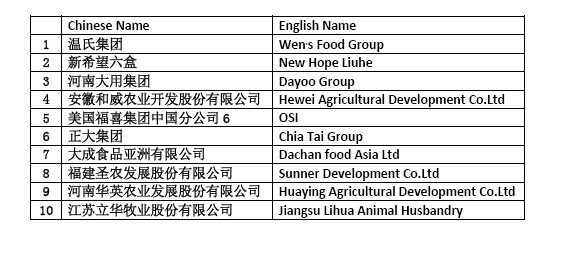
Michael Boddington from Asian Agribusiness Recruitment Training Development (AARTD) has been involved in agribusiness in Asia since 2000. AARTD has office both in Vietnam Ho Chi Minh City and China Beijing. So AARTD has a thorough understanding of the Vietnam and China agribusiness industry and produces up-to-date research reports on the market. We can offer insights on supply and demand trends and comments on the future structure of Asian agribusiness. If you would like to know more please email: michael@boddingtonconsulting.com
Source: www.WATTAgNet.com/worldtoppoultry.html
China-Australia Free Trade Agreement announced
The Australian red meat and livestock sectors will benefit by $11 billion from the elimination of tariffs negotiated under the China-Australia Free Trade Agreement (ChAFTA) announced by Australian Prime Minister Tony Abbott following his meeting with Chinese President Xi Jinping in Canberra today.
Under the Agreement, the tariffs currently levied on Australian beef of 12-25% will be eliminated over 9 years; sheepmeat and goat meat tariffs of between 15-23% will be eliminated over 8 years; the tariffs on offals of 12-25% will be eliminated over 4-10 years; the 5-14% tariffs on hides and skins will be eliminated over 4-8 years; and the 10% tariffs on live cattle and live sheep eliminated over 4 years.Once fully implemented an FTA with China has the potential to boost the gross value of beef production by $270 million annually by 2024. Out to 2030, the total benefits for beef will approach $3.3 billion.
For the sheep meat sector, the potential benefits are more than $150 million each year by 2024 – with the value over the next 16 years being in excess of $1.8 billion.As China is a destination for nearly 90% of Australia’s sheepskin exports and 80% of cattle hides, elimination of these tariffs, as well as those on offal, will add $436 million a year by 2024 across both beef and sheepmeat – and out to 2030, these benefits could total $6 billion.
“These ChAFTA benefits will add significant value to the Australian red meat and livestock industry and complement the gains derived from the other FTAs Australia has concluded to date,” Chairman of the Australian Red Meat ChAFTA Taskforce David Larkin said.
“The current tariffs imposed on Australian beef, sheepmeat and co-products exported to China represent an annual tax on the supply chain of around $826 million. The gradual removal of this cost burden will positively impact the profitability of Australian cattle and sheep producers, processors and exporters, not to mention alleviation of the inflated prices paid for Australian red meat and associated products by Chinese customers and consumers.”
The Australian red meat industry has been at a distinct competitive disadvantage in China given the very low tariffs that major competitor, New Zealand, has benefited from following the 2008 New Zealand-China FTA.“With New Zealand beef and sheepmeat gaining tariff free entry by 2016, it was vital that Australian red meat products were afforded similar (albeit lagging) access arrangements,” Mr Larkin said.
“As competition in China is also likely to escalate over the next few years as other suppliers potentially obtain improved access, Australia’s competitiveness is under threat – a demonstrable reason why Australia urgently needed a trade liberalising agreement.”Few other initiatives pursued by the Australian Government could do more to improve supply chain returns than a true free trade agreement with China.
”Mr Larkin thanked the Prime Minister, the Minister for Trade and Investment and his negotiating team for their efforts in what had been difficult and protracted negotiations.
“Such an advantageous outcome will help to favourably position the Australian red meat and livestock sector for years to come. In so doing, the existing commercial relationships with China will ascend to the next level,” Mr Larkin said.
In 2013, 154,833 tonnes of beef; 97,423 tonnes of sheepmeat; 4,736 tonnes of goat meat; 8,044 tonnes of offal; 66,530 head of live cattle (predominantly dairy cows) and 3,472 live sheep were shipped from Australia to mainland China – representing an export return of $1.3 billion. China is also a significant market for co-products with the combined value of offal, hide, sheepskin, tallow, meat & bone meal and pet food exports worth over $1 billion.
Michael Boddington from Asian Agribusiness Recruitment Training Development (AARTD) has been involved in agribusiness in Asia since 2000. AARTD has office both in Vietnam Ho Chi Minh City and China Beijing. So AARTD has a thorough understanding of the Vietnam and China agribusiness industry and produces up-to-date research reports on the market. We can offer insights on supply and demand trends and comments on the future structure of Asian agribusiness.If you would like to know more please email:michael@boddingtonconsulting.com
Source: http://www.mla.com.au/News-and-resources/Industry-news/China-Australia-Free-Trade-Agreement-announced
China coming Great Milk Battle
In China, the great milk battle is coming. Two opposing forces are setting the trend. On one hand there is this ever-growing demand of milk, induced by westernization and 30 years of opening policy. On the other hand, plays this suspicion against milk produced by local brands, as the long lasting result of the melamine scandal in 2008 (where 18 local dairies were caught red-handed adding melamine into their fresh milk, causing damage to 300,000 babies’ kidneys): therefore the Chinese want milk but prefer the imported products.
Under this cross-fire, the Chinese milk sector undergoes a furious transformation. Virtually all family husbandries have sold their cow(s). “Small” farms of less than 100 cows still account for 60% of the production, but giant private dairy farms appear almost by the day, encouraged by State and bank credit. Each keep at least 10,000 heads of imported breed, mostly Holstein for a bigger daily milk flow (on average 12,000 pounds/year, compared to 20,000 in the US). The biggest has 140,000 – milking is robotized, performed in eight rotary, 80-bail milking parlors with cooling and self-cleaning piping systems to maintain high standards of hygiene. Those farms also typically equip themselves with automated systems for feed control, temperature control, fresh bedding and litter disposal. Mengniu and Yili, the two Chinese leaders in fresh milk, both cross the bar of 10.000 tons of fresh milk collected every day.
In 2012, China was producing 37.4 million tons of fresh milk and was the world’s third largest producer. 14.3% of the milk it consumes is imported: this percentage will grow to 34,5% next year. In 2013, China’s purchase accounted for two-third of the world milk powder market, which covered 54% of its needs, at the cost of $16.34 billion. Then in the first half of 2014, China imported 750.000 tons of milk powder from New Zealand, its main provider (dubbed the “Saudi Arabia of milk”) – the equivalent of an entire year’s import from last year.
However the average Chinese only consumes 30 kilos of milk per year, compared to 70 to 80 kilos to his Korean or Japanese neighbors. He is ready to double his intake, and he can pay for it: the prices paid for milk inside China, whether fresh milk or powder, are higher than the world average, due to the pressure of a demand that the country can’t satisfy alone.
This helps to explain the rush to which all players prepare themselves, international and local dairies alike, to get their fair share of this potential Eldorado. In February, DANONE paid $665 million and allied itself with Arla (Denmark) and Cofco (China) to control together 31.5% of Mengniu, China’s market leader. In July, Fonterra (New Zealand) bought 20% of the Chinese group Beingmate (10% of the powder market) for $514 million, and Alibaba (China’s No.1 local online sales portal) took over 60% of a unit of dairy giant Yili, in Inner Mongolia for $328 million.
Nestlé of course does not stay sitting on the side. After having for 30 years collected the milk of hundreds of small farmers from the Northeastern region, the Vevey conglomerate started to create its own milk sourcing, combining volume and reliability. Until 2018, together with Shanghai Milk, it will put $408 million into a network of big milk farms around Shuangcheng (Heilongjiang). At the core of its system, its top-end training center, at a price tag of $31 million, opened mid-October in Shuangcheng with the training input of many foreign companies and universities. It will convert its students into experts of husbandry, feeding, automation and many other skills, as a support to these new farms – its own, and many others.
A last player stays in the backstage and cannot wait to join the bandwagon: the European milk sector, which has been hampered for 30 years by a quota system that still freezes its production to 154.6 million tons per year (20% of the world production). But in March 2015, quotas will disappear, restoring production freedom, one result of the “Green Europe” overall reform. Countries like Ireland, Denmark, the Netherlands, Germany or France are busy investing into further capacities: almost all their extra production will go to China.
However Australia raises the alarm: “Within five years, those massive Aussie cow exports to China will get that country self-sufficient. Within 10-15 years, it will become one of our major competitors,” claims Darryl Cardona, COO of United Dairy Power. Indeed, according to Euro monitor, with a value of $70 billion in 2019, the Chinese dairy market will have overtaken the American one as the world’s No.1. From then on, the Chinese dairy sector which had started from nowhere 20 years earlier would be an exporting hub, endowed with an unbeatable economy of scale and pricing power…
Such a fear may be far-fetched: in the long run, China is going to stay under pressure to feed its 1.3 billion mouths, too busy to even think of exporting food. But domestic players, even those with no food experience at all, are going into foreign milk acquisition. In October, Evergrande, the Cantonese real estate developer, bought 60% of New Zealand’s milk group Cowala – it then starts advertising in stadiums, on the shirts of its own soccer team, for its new milk formula joint venture.
Now for obvious reasons, this interconnection between Chinese and international milk producers is the best chance for them to hedge against the risk of a future closure of a self-sufficient Chinese market. The other, even better way to do so, is to produce within China. From this perspective, the group with the best bet on future might be Nestlé, with one foot into each shoe, and last year already accounting for 25% of the Chinese baby formula market.
Michael Boddington from Asian Agribusiness Recruitment Training Development (AARTD) has been involved in agribusiness in Asia since 2000. AARTD has office both in Vietnam Ho Chi Minh City and China Beijing. So AARTD has a thorough understanding of the Vietnam and China agribusiness industry and produces up-to-date research reports on the market. We can offer insights on supply and demand trends and comments on the future structure of Asian agribusiness. If you would like to know more please:
Email:michael@boddingtonconsulting.com
http://www.forbes.com/sites/ericrmeyer/2014/10/30/china-and-its-impending-great-milk-battle/
Evergrande Group Cooperate with New Zealand brand Kaicare infant formula
In 27th October, Evergrande Group held the market conference declaring that the New Zealand brand- Karicare infant formula officially entered the domestic dairy market. Evergrande Group acquisition of New Zealand brand karicare infant formula. Evergrande Dairy Group was officially established in September. The same month, Evergrande Group acquired karicare, produce karicare wow bear infant formula; karicare become another foreign high-quality milk powder brands to enter the Chinese market. New Zealand`s Ecological pure, vast green spaces, dairy industry has always been the lifeblood of the world’s natural pastures country -New Zealand.
On the technical side, karicare using Australia and New Zealand’s largest multinational pharmaceutical group of pharmaceutical grade GMP standard production, through a number of stringent testing, one yard-one jar original video production traceability system, so that the real “safety traceability.” From the May of this year, foreign infant formula manufacturers have to through the identification, approve, registration than export to China. With excellent quality, Karicare became the first registered New Zealand infant formula manufacturer. In the first batch of the world’s 13 countries only 41 infant formula manufacturers obtain the registration.
Michael Boddington from Asian Agribusiness Recruitment Training Development (AARTD) has been involved in agribusiness in Asia since 2000. AARTD has offices both in Vietnam, Ho Chi Minh City and China Beijing. AARTD has a thorough understanding of the Vietnam and China agribusiness industry, and produces up-to-date research reports on the market. We can offer insights on supply and demand trends and comments on the future structure of Asian agribusiness. If you would like to know more please email: michael@boddingtonconsulting.com
Source: http://www.boyar.cn/article/2014/10/27/582988.shtml
The decline in live pig prices limited Shuanghui development
After the Shuanghui Development fell 5% in 24th Oct, the stock price intraday limited in 27th Oct. According to the report in the last half year, Shuanghui development occupies 30% in Wanzhou International business Company, and therefore Wanzhou International Company also has been dragged down. Stock prices washings fell 14% to a new low price.
According to the third season`s report about Shuanghui development, revenue of the third season is 12.111 billion Yuan, fell 0.69% year on year; Net profit is 9.65 million Yuan, fell 15.68%. 1-3 season`s revenue is 33.1 billion Yuan, increase 2%; Net profit is 31.6 billion, increase 11.5%. One of the important reasons for Wanzhou International shares fell is poor performance in the three seasons, and had a large gap between the industry’s growth expectations, or as the initiator of this Shuanghui Development.
ShuangHui development performance was remarkable in last half year,
Why crashed out in the third season? Some peoples think that the three seasons live pig prices down, cause Shuanghui performance as expected. On live pig prices, the pork price in the first half year, especially in the second season, not as good as the third season. Why second-season net profit increase up to 17%? Therefore, JingShu believes that live pig prices down is the main reason of ShuangHui development limited.
Michael Boddington from Asian Agribusiness Recruitment Training Development (AARTD) has been involved in agribusiness in Asia since 2000. AARTD has offices both in Vietnam, Ho Chi Minh City and China Beijing. AARTD has a thorough understanding of the Vietnam and China agribusiness industry and produces up-to-date research reports on the market. We can offer insights on supply and demand trends and comments on the future structure of Asian agribusiness. If you would like to know more please email: michael@boddingtonconsulting.com
Source: http://www.feedtrade.com.cn/news/review/2014-10-27/2020336
China’s largest Baijiu company-Wuliangye Group enter the animal feed industry Cooperative with NewHope LiuHe
US “Forbes” website biweekly 21th October article, the original title: to feed China, first feed the animals. China’s largest Baijiu Company – Wuliangye Group made an unusual move – to enter the animal feed industry. Of course, the cattle will not drink Wuliangye. Wuliangye Group wants to scrap the distilled grain, make a commercially viable, high-protein feed.
National liquor brands enter the animal feed industry that could create a small programs for solution to China’s food safety problems, China need feed 1.3 billion people, but the first thing to do is to feed the animals which produce meat and milk. China’s pork and fish production respectively accounted for 50% and 70% of the world. Animals feed industry is very important for livestock and aquaculture crucial support.
What is the relationship between all of this and Wuliangye enter the feed industry? “NewHope LiuHe” cooperates with animal feed producers and comprehensive agribusiness-Wuliangye, occurred in China revalued its dependence on foreign animal feed imports time. In the United States, dried distillers grains accounted for 10% -30% of livestock or fish feed, while China hasn`t achieve the industrial production of dried distiller grains. China is the world’s largest importer of distillers dried grains, 2013 to buy about half of world trade dried distillers grains, was 28% in 2012.
Michael Boddington from Asian Agribusiness Recruitment Training Development (AARTD) has been involved in agribusiness in Asia since 2000. AARTD has offices both in Vietnam, Ho Chi Minh City and China Beijing. AARTD has a thorough understanding of the Vietnam and China agribusiness industry, produces up-to-date research reports on the market. We can offer insights on supply and demand trends and comments on the future structure of Asian agribusiness. If you would like to know more please email: michael@boddingtonconsulting.com
Source: http://www.feedtrade.com.cn/news/enterprise/2014-10-23/2020281.htm
Huishan Dairy and FrieslandCampina enter into first Chinese infant milk formula joint venture
China Huishan Dairy Holdings Company Limited (‘Huishan Dairy’) and Royal Friesland Campina N.V. (FrieslandCampina) have entered into a joint venture with the purpose of operating a fully integrated infant milk formula supply chain in the People’s Republic of China. The agreement, which follows talks held in May, was signed by the companies’ two CEOs: Yang Kai of Huishan Dairy and Cees ‘t Hart of FrieslandCampina. This joint venture is the first between a Chinese and a foreign dairy company that will locally manufacture, market and distribute infant milk formula. Both companies will own 50 percent of the shares in the joint venture while continuing to operate their existing infant formula businesses separately. As such, Huishan will carry on marketing its own brands and FrieslandCampina’s Friso brand will continue to be exclusively produced in the Netherlands and imported and marketed by FrieslandCampina in China.
Michael Boddington from Asian Agribusiness Recruitment Training Development (AARTD) has been involved in agribusiness in Asia since 2000. AARTD has office both in Vietnam Ho Chi Minh City and China Beijing. So AARTD has a thorough understanding of the Viet Nam and China aqua industry and produces up-to-date research reports on the market. We can offer insights on supply and demand trends and comments on the future structure of Asian agribusiness. If you would like to know more please email: michael@boddingtonconsulting.com
Source: http://www.frieslandcampina.com/english/news-and-press/news/press-releases/2014-10-08-huishan-dairy-and-frieslandcampina-enter-into-joint-venture.aspx


