
Trump nominee for China ambassador pledges to “positively influence” US-China relationship
 |
|
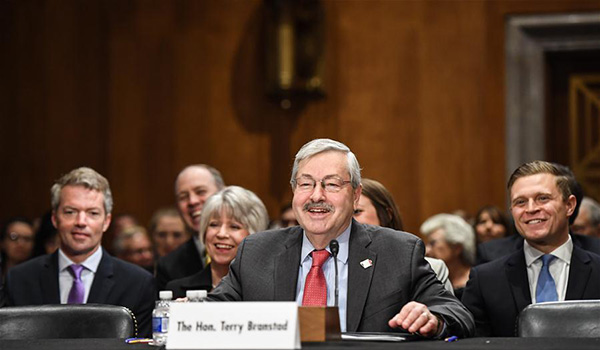
Iowa Governor Terry Branstad (Front) testifies before the US Senate Foreign Relations Committee on a hearing considering him to be US Ambassador to China on Capitol Hill in Washington DC, the United States, on May 2, 2017. US President Donald Trump’s pick for Ambassador to China, Terry Branstad, said on Tuesday that if confirmed, he would work to “positively influence” the US-China relationship. [Photo/Xinhua] |
WASHINGTON – US President Donald Trump’s pick for Ambassador to China, Terry Branstad, said on Tuesday that if confirmed, he would work to “positively influence” the US-China relationship.
“As Governor of Iowa, I saw first-hand the importance of a positive and healthy trade relationship between our two countries,” Branstad said here at his confirmation hearing.
If confirmed, he hoped to work towards the goal of positively influencing the US-China relationship, he added.
As the governor of a US state whose economy is mainly driven by agriculture industry, Branstad noted that almost one out of every two rows of Iowa soybeans is sent to China, as well as 33.5 million US dollars in pork in 2016.
However, the importance of trade between the United States and China extends well beyond agriculture, he said.
“Aviation products, manufactured goods, chemicals, electronics, and many other products and services are exported to China daily and help support and sustain the American economy,” he told US lawmakers.
Calling US-China relationship “multi-faceted,” Branstad also noted that the two countries must work together on major security issues, including the denuclearization on the Korean Peninsula and cybersecurity.
Branstad also said that he looked forward to “connecting with the Chinese people and continuing a vibrant exchange of culture and ideas.”
Branstad, 70, is the longest-serving governor in the United States, who also has long nurtured a close relationship with China and has visited China multiple times.
He served as the governor of Iowa in 1983-1999, and again since 2011. He was nominated by Trump to be the next US ambassador to China in December 2016.
Source:Xinhua
China, Vietnam to hold joint fishery inspection
SANYA, April 17 (Xinhua) — Two Chinese maritime police vessels on Monday left here for a China-Vietnam joint fishery inspection.
The inspection in the Beibu Gulf involves two police vessels from each side and will be conducted over three days, ending Thursday.
Maritime police will observe the fishing activities and occasionally board fishing boats to carry out random checks, according to China’s maritime police authorities. The two sides will also discuss ways of improving cooperation.
The gulf is a traditional fishery ground for fishermen of both countries. China and Vietnam signed an agreement on the demarcation of the gulf in 2000. Deals on peaceful exploitation of resources were later signed.
Joint inspections began in 2006 as an annual event, and were increased to twice a year in 2016.
Chinese maritime police said the joint inspection provided a means for smooth contact with their Vietnamese counterparts, creating a peaceful and harmonious environment for the fishermen.
DATE:2017-04-18 SOURCE:Xinhua News Agency
Scenery of terraced fields in Guizhou
Scenery of terraced fields in Guizhou

Aerial photo taken on April 17, 2017 shows scenery of terraced fields in Qiandongnan Miao and Dong Autonomous Prefecture, southwest China’s Guizhou Province. (Xinhua/Wang Bingzhen)

Aerial photo taken on April 17, 2017 shows scenery of terraced fields in Qiandongnan Miao and Dong Autonomous Prefecture, southwest China’s Guizhou Province. (Xinhua/Wang Bingzhen)

Aerial photo taken on April 17, 2017 shows scenery of terraced fields in Qiandongnan Miao and Dong Autonomous Prefecture, southwest China’s Guizhou Province. (Xinhua/Wang Bingzhen)

Aerial photo taken on April 17, 2017 shows scenery of terraced fields in Qiandongnan Miao and Dong Autonomous Prefecture, southwest China’s Guizhou Province. (Xinhua/Wang Bingzhen)
China’s Belt and Road Initiative ushers in ‘Globalization 2.0’: experts

By Jiang Jie 16:37, April 12, 2017
China’s Belt and Road Initiative is drawing on a new type of regional strategy that can lead to “Globalization 2.0,” said a renowned Chinese expert on international relations.
According to Zhang Yunling, director of the academic division of International Studies at the Chinese Academy of Social Sciences (CASS), humanity entered the era of “Globalization 1.0” after World War II, focusing on connecting the world via multilateral and regional cooperation. Prior to 2008, Globalization 1.0 has indeed promoted rapid economic growth, but the anti-globalization trend is always waiting, ready to strike, as imbalanced development between regions and communities is inevitable, Zhang noted.
The Belt and Road Initiative, on the other hand, offers a distinctly Chinese way of looking at global governance and cooperation.
“We try to improve the geographic advantages forged after industrialization in the West, which favors oceanic powers … By connecting interior land, we are re-constructing these geographic advantages so that inland regions can also profit,” Zhang explained.
“It should be emphasized that the Belt and Road Initiative is not a project. It is an initiative, a method. It is not only about routes drawn on a map, but also about suggesting a direction and covering neighboring regions,” Zhang emphasized.
The remarks were made at a press conference in Beijing on April 12, where CASS unveiled its latest publication with Social Sciences Academic Press (SSAP). Xie Shouguang, director of SSAP, said at the conference that the publication is especially significant since the Belt and Road Forum for International Cooperation is scheduled to be held in May.
The forum will take place in Beijing on May 14 and 15. It will explore ways of addressing regional and global economic issues, generate fresh energy for interconnected development, and help the Belt and Road Initiative deliver greater benefits to all the people and countries involved, Xinhua News Agency reported.
“The versions of globalization led by the East and the West are different. The West tends to be more aggressive, while the East emphasizes inclusiveness. That makes homogeneity one of the key factors in cooperation, but we are trying to show that heterogeneity does not necessarily get in the way of cooperation,” said Ren Jingjing, another expert with CASS.
SOURCE:People’s Daily

‘Internet Plus’ to fuel brand-building for Chinese agricultural products

Chinese farmers should view product promotion through the lens of “Internet Plus,” said an official with the National Development and Reform Commission (NDRC) on April 12.
“Innovation has always been key in brand-building. We have long passed the time where farmers only toiled on their land. In our era, ‘Internet Plus’ must be highlighted. China is the world’s largest consumer of meat and crops, with an annual consumption of 50 kilograms and 450 kilograms per capita respectively. It is time that we promote our brand overseas,” said Song Chengmin, a macroeconomic management official with the NDRC, at a conference on agricultural branding in Linyi, Shandong province.
The conference was held by the Linyi government and the People’s Tribune on April 12. Its theme was the proposal made by Chinese President Xi Jinping in 2015 to strengthen brand-building for agricultural products.
Hu Xiaoyun, director of the China Academy for Rural Development at Zhejiang University, pointed out that it remains difficult to sell many Chinese agricultural products at high prices, even though they are equal in quality to their overseas counterparts.
“Even at some high-end venues in China, we are served foreign tea instead [of Chinese tea]. This is heartbreaking because tea originated in China and we see a huge amount of tea production every year,” Hu said.
In fact, China is not short of agricultural brands, but is enmeshed in an age of “wilderness,” according to Dang Guoying, a researcher with the Rural Development Institute at the Chinese Academy of Social Sciences.
Dang told reporters on the sidelines of the conference that a large crowd of small Chinese brands cannot win out against Western giants. To spur domestic agricultural development, authorities should encourage brand-building rather than offering blueprints.
“On top of the agenda is our mission to find a carrier to hold the brand. It is usually giant agricultural cooperatives that do this job in the West. There are reportedly up to 1 million co-ops in China, which is in fact bad for brand-building,” Dang explained. Echoing the NDRC official, Dang also agreed that access to the internet could bring down the cost of agriculture.
“With the help of the internet, some less developed regions have become known in other regions, and business deals have been made. This pattern could promote basic infrastructure construction,” Dang said, adding that a beneficial cycle could be perpetuated in rural areas to boost sales as well as brand-building.
SOURCE:People’s Daily

State Council to promote pilot program for land planning at provincial level

Updated: Apr 12,2017 5:10 PM
The State Council approved an inter-department joint meeting system for land planning at the provincial level, as an effort to push forward pilot work in space planning in provinces.
According to the document, the joint meeting should promote the pilot program in provinces and study major issues encountered in the process under the lead of the State Council.
The joint meeting should also evaluate work results and promote successful practices. Meanwhile, it should study laws and regulations involved in space planning, and undertake other tasks from the central government.
Currently, the joint meeting is composed of the National Development and Reform Commission, Ministry of Land and Resources, Ministry of Environmental Protection, Ministry of Housing and Urban-Rural Development, Ministry of Water Resources, Ministry of Agriculture, State Forestry Bureau, State Oceanic Administration, and State Bureau of Surveying and Mapping.
In the future, the joint meeting may bring in other members as needed.

Roslin Technologies completes £10 million seed funding round to become the largest Agritech start-up in UK history

Roslin Technologies Ltd. has successfully raised £10 million from institutional investors The British Innovation Fund.
The Agritech start-up is jointly owned by the University of Edinburgh, agriculture-focused private equity advisors JB Equity and The British Innovation Fund, a Milltrust International fund, with cornerstone commitment from The Royal County of Berkshire Pension Fund.
Roslin Technologies aims to commercialise the intellectual property and know-how of the University’s Roslin Institute and The Royal (Dick) School of Veterinary Studies, the UK’s leading vet school, revolutionising agricultural productivity on a global scale through ground-breaking science.
Based at University of Edinburgh’s Easter Bush Campus, the company takes advantage of facilities and infrastructure that has benefitted from more than £200m of investment over the past five years, making the campus the largest concentration of animal science in Europe.
Among the first technologies planned for commercialisation are a low-cost manufacturing system to produce therapeutic proteins in chicken eggs, allowing drug discovery for diseases; methods for biobanking poultry germplasm to preserve genetic diversity for future generations; and novel vaccines and diagnostics for veterinary markets to enhance animal welfare.
“This investment recognises the strength of the University’s innovation capacity and cements our position as one of the world’s leading research-intensive universities,” said Sir Timothy O’Shea, Principal and Vice-Chancellor of the University of Edinburgh.
Mr Griff Williams, co-founder of Milltrust Agricultural Investments and Chief Investment Officer of the British Innovation Fund said, “With a global population increasing beyond nine billion by 2040, innovation and investment in animal science and sustainability will be critical to ensure global food security. Roslin Technologies provides us with the opportunity to couple sustainable impact with generating investor returns.”
Mr Glen Illing, CEO of Roslin Technologies and partner in JB Equity said, “We are thrilled to welcome the British Innovation Fund as partner in our joint venture with the University of Edinburgh. There is incredible demand for innovations that address desperately needed productivity increases in agriculture. This investment allows us to deliver a technology pipeline that spans across The Roslin Institute’s core focus on food, environmental security and animal and human health.
ENDS

JD.com to build 150 operation sites for drone delivery in Southwest China

CHENGDU – Chinese e-commerce giant JD.com said Thursday it will build 150 operation sites for unmanned aerial vehicle delivery in southwestern province of Sichuan.
JD.com CEO Richard Liu said the operation sites are expected to open in three years and the drone delivery will help reduce the freight costs by 70 percent.
The drone service will deliver Sichuan’s products to shoppers nationwide within 24 hours and will improve delivery efficiency in remote mountainous areas in Sichuan, Liu added.
JD.com has been developing drone delivery to meet the rising retail demand in China’s rural areas, where complex terrain and underdeveloped infrastructure have compromised timely human courier delivery.
JD.com said its drones, which can carry 50 kilograms of parcels, have been put into use and drones that can carry 500 kilograms are in the pipeline.
The company’s drone delivery project has received approvals in some provinces, and planning of air routes began in May.
SOURCE:China Daily

Global food prices fall in March

Xinhua, April 7, 2017
The Food Price Index of the Food and Agriculture Organization (FAO) on Thursday reported that global food prices fell in March amid large available supplies and expectations of strong harvests, and also projected “robust cereal harvests” in 2017.
FAO’s Food Index “shows a decline in March, as sugar and vegetable oils slide,” UN spokesman Stephane Dujarric said at a daily news briefing here.
FAO also released its first world cereal supply and demand outlook for the year ahead, expecting it to be “another season of relative market tranquillity” with grain inventories remaining at near-record levels, Dujarric added.
The FAO Food Price Index, which measures the monthly change in international prices for cereals, vegetable oils, dairy, meat and sugar, averaged nearly 171 points in March, marking a 2.8 per cent drop from the previous month while remaining 13.4 percent above its level a year earlier, according to the agency.
Cereal prices declined 1.8 percent from February, led down by wheat and maize. It is now roughly par with its March 2016 level.
Vegetable oil prices fell 6.2 per cent on the month. Palm oil and soy oil quotations were both lower in March on the back of improving production forecasts, while those of rape and sunflower seed oils also declined due to higher-than-expected availabilities.
Sugar prices plummeted 10.9 per cent to its lowest level since May 2016 amid weak import demand and expectations of robust Brazilian supplies entering world markets as a result of strong harvests and slower domestic uptake for bio-ethanol production.
Dairy prices dropped 2.3 percent due to buoyant milk supplies, but remained well above its year-ago level.
Meat prices rose 0.7 percent, led by firm import demand from Asia for bovine meat and pigmeat.
Meanwhile, FAO also released its first world cereal supply and demand outlook for the year ahead, saying that worldwide cereal production in 2017 is projected at 2,597 million tonnes, just nine million tonnes short of the record set in 2016.
Global wheat production is expected to fall 2.7 percent in 2017 to 740 million tonnes mostly on price-induced planting cuts in Australia, Canada and the United States.
By contrast, total production of coarse grains in 2017 is provisionally expected to rise to a new record level of 1,353 million tonnes, substantially thanks to a surge in production in Brazil and Argentina along with a rebound in South Africa after last year’s drought.
SOURCE:China.org.cn
Vice Minister Qu Dongyu attends China-CEEC Agricultural Products and Wine Fair in Bosnia and Herzegovina

Vice Minister Qu Dongyu led a delegation to the China-CEEC (16+1) Agricultural Products and Wine Fair in Bosnia and Herzegovina (BiH) on 4 April 2017. Businesses from the wine, Chinese wolfberry and potato staple food sectors attended the Fair with their booths covering around 1/8 of the total exhibition area.
The Fair was among the cooperation items set forth in the Riga Guidelines for Cooperation between China and CEECs of the Fifth Summit of China and CEECs in November 2016 and was the first of its kind to be held during the Mostar International Trade Fair, indicating CEECs’ strong desire to boost 16+1 cooperation based on traditional activities. The Fair was attended by Croatian Prime Minister Andrej Plenkovic, Montenegrin President Filip Vujanovic, Serbian President-elect Aleksandar Vucic, and delegations from all CEECs.
During the Fair, Mr. Qu held meetings with the Croat Member of the BiH Presidency Dragan Covic, BiH Chairman of the Council of Ministers Denis Zvizdic and BiH Vice Chairman of the Council of Ministers and Minister of Foreign Trade and Economic Relations Mirko Sarovic respectively. The BiH leaders spoke highly of the historic opportunities provided by the 16+1 cooperation to CEECs and appreciated the MOA’s strong support for the Fair. They hoped the two agricultural ministries could sign cooperation agreements as soon as possible and conduct pragmatic cooperation on the production and processing of BiH competitive products such as raspberry, strawflower and beef.
Mr. Qu noted that China’s participation in the Fair reflects China’s consistent attention to the 16+1 cooperation. The MOA will earnestly implement the Riga Guidelines, continue to provide free-of-charge exhibition space for premium CEEC wines and other kinds of alcohol at the National Agriculture Exhibition Center, and encourage Chinese businesses and related research and educational institutes to CEECs to conduct agricultural cooperation in areas of trade and investment, research and development and personnel training to improve the China-CEEC agricultural cooperation. The MOA looks forward to signing the bilateral agricultural cooperation agreement with BiH at an early date, consolidating the foundation of bilateral cooperation and rendering a more visible role played by BiH under the 16+1 framework.
Mr. Chen Bo, Chinese Ambassador to BiH, attended the above-mentioned activities.
SOURCE:MOA Information Office


